
Some links below go to product pages on this site that link to Amazon. As an Amazon Associate we earn from qualifying purchases. Product sizes come from the makers’ listings; we haven’t tested these items in person.
For most under-bed bins and bags you need about 7½ to 8 inches of clearance. Typical low-profile containers are around 7 inches tall (the five we list range from 6.7 to 7.3 inches), and you want at least half an inch spare so the container slides in without scraping. The number that matters is the distance from the floor to the lowest thing under your bed, which is usually the side rail or a support bar, not the top of the frame.
That second point is where most returns come from. A bed sold as “14 inches high” doesn’t give you 14 inches underneath, because the rails, slats and support bars all hang below the top. The rest of this guide shows how to find your real clearance, how much room the bed’s legs leave along the side, and what to do when the gap is too small.

How to measure under-bed clearance
You only need a tape measure and two minutes. Do it with the mattress on the bed, since the weight can make some frames sit a little lower.
- Find the lowest point along the side you’ll load from. Look under the edge of the bed. On most frames it’s the bottom of the side rail; on some it’s a bracket, a cross-bar or a slat that hangs lower. That lowest point is your ceiling.
- Measure from the floor straight up to that point at the head end, the middle and the foot end. Floors and frames are rarely perfectly level. Use the smallest of the three numbers.
- If there’s a rug, press the tape into the pile. A container rides on top of a rug, so a thick rug takes height away.
- Measure the usable length along the side: the distance between the inside faces of the legs, plus any legs partway along the rail. This decides how many containers fit end to end.
- Check how far in you can go. Queen and king frames usually have a center rail with extra legs under the middle of the bed. Measure from the edge of the bed to that rail if your containers are deep.
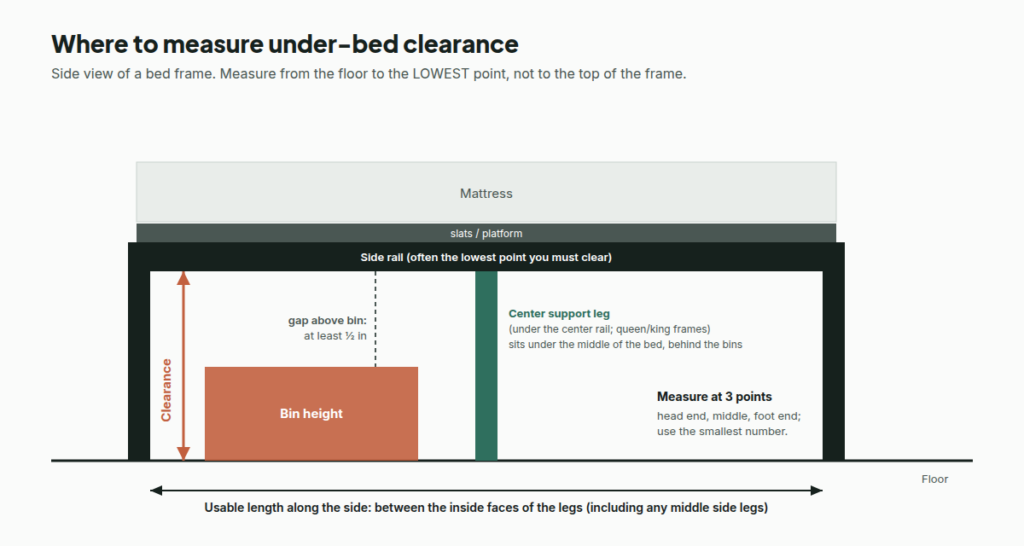
Subtract half an inch from your smallest height reading. That’s the tallest container you should buy. We use half an inch as our own rule of thumb: it covers small differences in the floor, a bag that bulges when it’s full, and a rug that isn’t perfectly flat. If a container’s maker states a minimum clearance, use whichever figure is larger.
What fits at each clearance
Here’s how that rule works out for the under-bed containers we list, using the heights from the makers’ own listings.
| Container | Height | Maker’s stated clearance | Clearance we’d want |
|---|---|---|---|
| Rolling drawers with wheels (2-pack) | 6.7 in (with wheels) | More than 7 in | 7¼ in |
| Storage bins with clear window (4-pack) | 7 in | Not stated | 7½ in |
| Storage bags with clear lids (4-pack, 95 L) | 7.1 in | Not stated | 7⅝ in |
| Extra-long rolling storage, 36 in (2-pack) | 7.3 in | 7.5 in or more | 7¾ in |
Low-profile under-bed storage (about 7 inches tall)
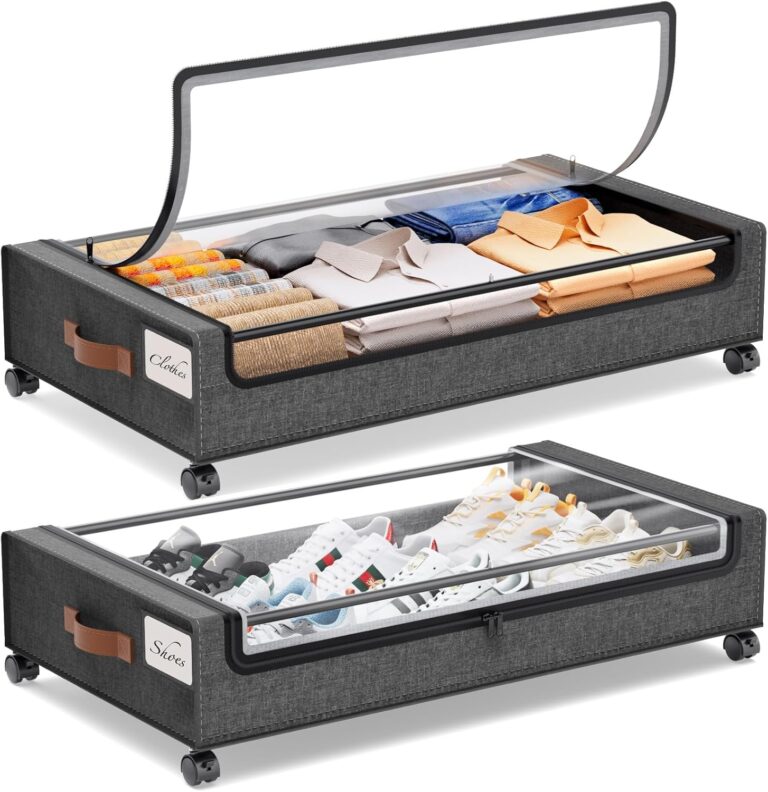
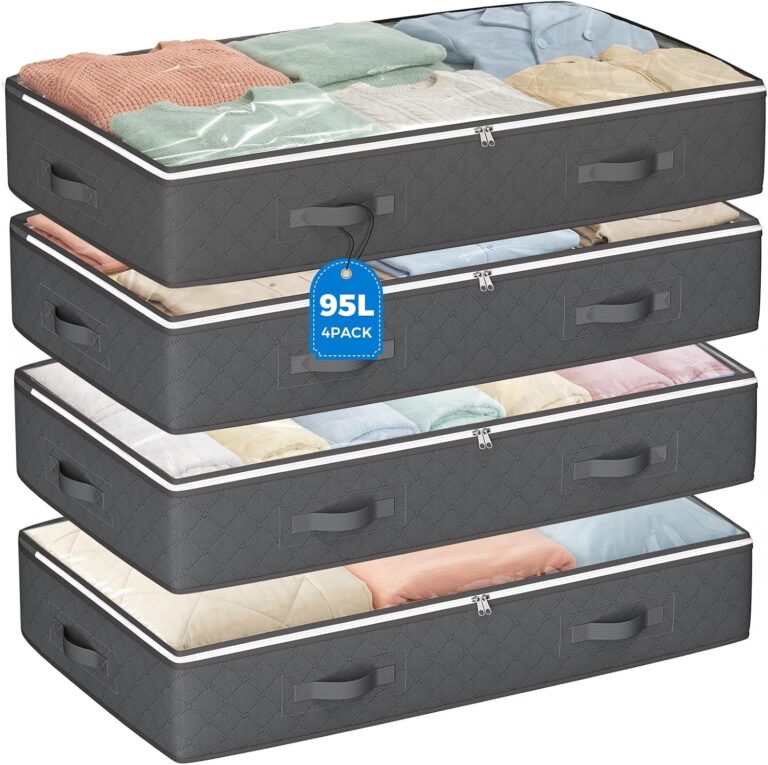
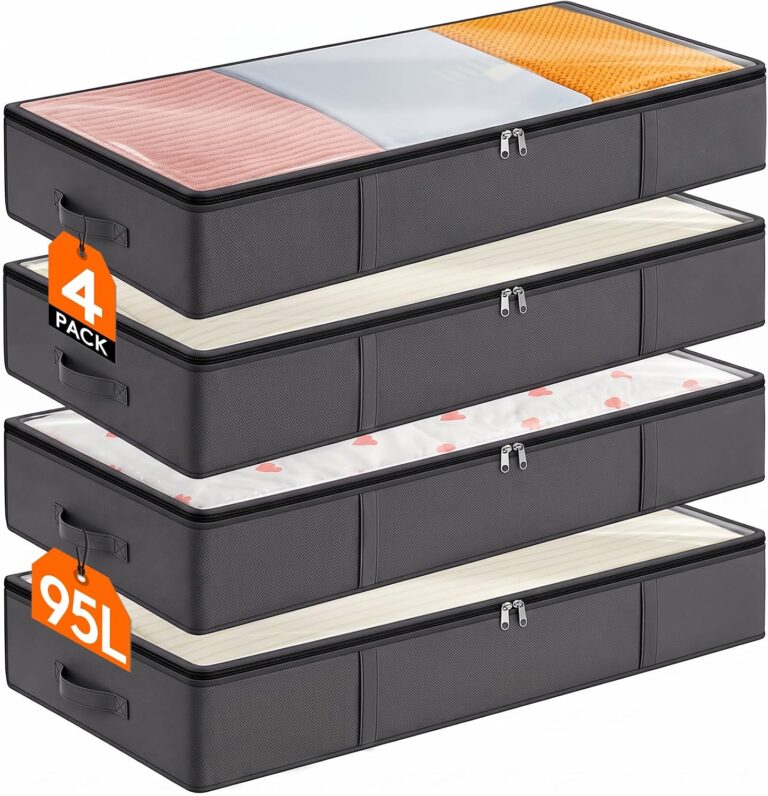
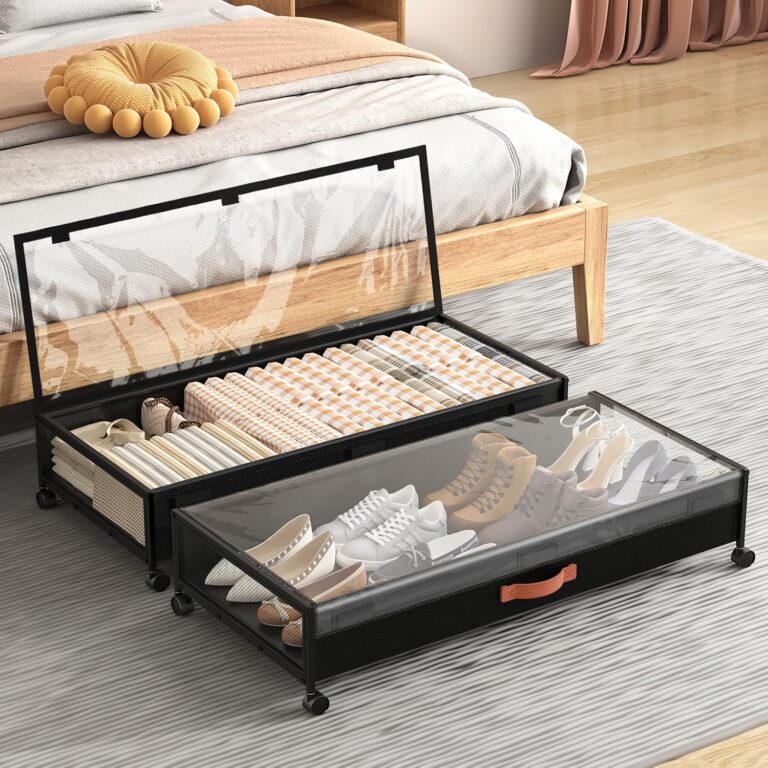
If you measured less than about 7¼ inches, none of these will slide in comfortably. Skip ahead to what to do if your bed is too low.
Soft bags are a little more forgiving than rigid bins because you can underfill them, but don’t count on squashing a full bag to fit. Fabric that’s forced against a rail wears through and is hard to pull out.
How many containers fit along one side
Height gets all the attention, but length is where plans fall apart. Under-bed containers are long, and bed legs take up room at each end.
A standard US queen mattress is 60 by 80 inches and a full is 54 by 75 inches (mattress size guide). Frames are usually a little bigger than the mattress, but the legs and corner brackets eat into the space underneath. So the length you can actually use along the side is often a few inches less than the mattress length.
Worked example: a queen bed. Say you measure 77 inches between the inside faces of the legs along one side.
- Two 39-inch bins need 78 inches end to end. They won’t fit, even though the mattress is 80 inches long.
- One 39-inch bin plus one 30.7-inch rolling drawer needs about 70 inches. That fits, with room to grip the handles.
- Two 30.7-inch rolling drawers need about 61½ inches. Fits easily.
On a full or twin, which are 75 inches long, two 39-inch containers won’t fit on one side at all. Plan on one long container per side, or two shorter ones.
Depth is rarely the problem on a queen or king: a 20-inch-deep bin stops well short of the middle of a 60-inch-wide bed. It matters on narrow beds and when you load from one side only. If the bed is against a wall, you get one row of containers, not two.
Why queen and king beds have legs in the middle
If you’re shopping for a new frame with storage in mind, expect legs under the middle of larger beds. Tempur Sealy, for example, says its mattresses need a frame with center support and at least five to six legs for queen, king and California king sizes, and that using an approved support helps protect the warranty (Tempur Sealy support guidelines). Other mattress makers have similar rules, so check your own warranty before removing any legs to make space.
Those extra legs usually sit under a center rail running head to foot, so they don’t block containers slid in from the side. They do split the space into two halves, which is why it pays to measure how far in you can go.
What to do if your bed is too low
Raise it with bed risers. Risers are sold in common heights of 3 and 5 inches, and some sets stack to give 8 inches (example riser set). Before buying, check three things:
- Your bed’s legs fit inside the riser’s cup. Listings usually give a maximum leg width.
- Every leg gets a riser, including any center legs. A frame raised at the corners but not in the middle loses the support the mattress maker requires.
- The riser’s weight rating covers the bed, mattress and people.
Raising the bed also changes how high you climb in, and it can leave a gap above a headboard that’s mounted to the wall.
Or switch to a taller frame. Some platform frames are designed with storage in mind. Zinus’s 14-inch SmartBase, for example, is listed with about 12.5 to 13 inches of clearance underneath, depending on the listing (SmartBase listing). That’s enough for any of the 7-inch containers above, with plenty to spare.
Or store it somewhere else. If you can’t gain the height, use taller containers in a closet instead. Our zippered blanket storage bags, for example, are about 12.4 inches tall. That’s too tall for nearly any bed but sized for a closet shelf. If it’s clothes you were planning to slide under the bed, a slim 4-drawer fabric dresser (15.7 inches wide) takes up very little floor space instead.
If your bed is too low: store it here instead
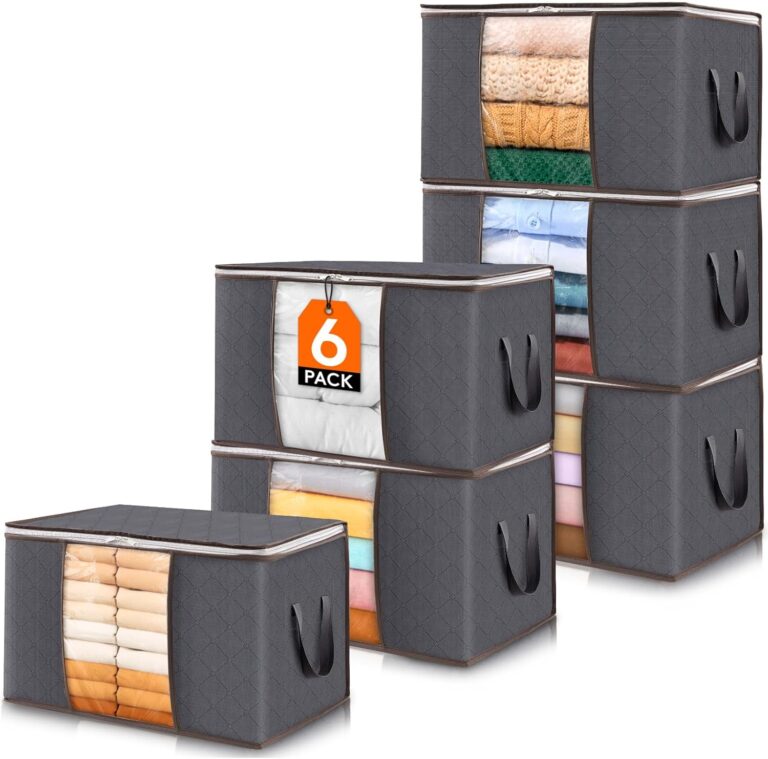
Zippered Blanket Storage Bags (6-Pack, 60 L Each)
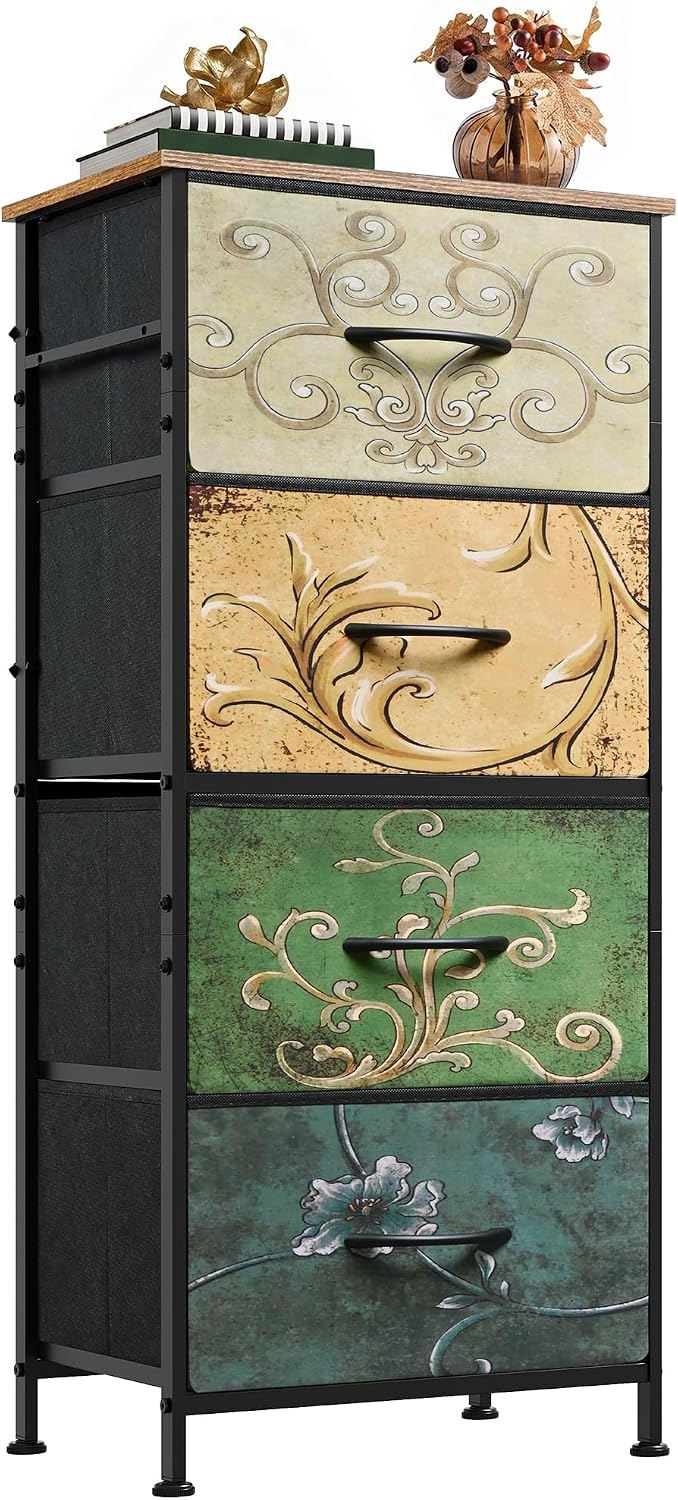
Slim 4-Drawer Fabric Dresser & Nightstand (Floral)
A quick check before you buy
- Smallest height reading, minus half an inch, is at least the container’s height (or the maker’s stated clearance).
- Total length of the containers on one side, plus a couple of inches to grab them, fits between the legs.
- Nothing hangs low midway along the rail, such as a bracket, a cross-bar or a sagging slat.
- For wheeled drawers: the floor is smooth enough for them to roll, and the rug edge won’t catch them.
Which one should you buy?
Start with your smallest clearance reading. Under 7¼ inches, none of these will slide in comfortably, so raise the bed or use the closet options above. Otherwise, match your gap to one of these:
- 7¼ to 7½ in gapRolling Under-Bed Storage Drawers with Wheels (2-Pack)Shop now
- 7½ in or more · binsUnder-Bed Storage Bins with Clear Window (4-Pack)Shop now
- 7⅝ in or more · bagsUnder-Bed Storage Bags with Clear Lids (4-Pack, 95L)Shop now
- Queen or king · 7¾ in+Extra-Long Rolling Under-Bed Storage, 36" (2-Pack)Shop now
The rolling drawers are the lowest here at 6.7 inches. The 4-packs give you the most storage (four containers, each about 39 by 20 inches), but check the length along your bed first. The extra-long 36-inch rolling containers suit queen and king beds when you’d rather roll things out than drag them.
You can enter your measurements in our Will It Fit? tool to see which products have sizes we’ve checked against their listings. You can also browse all bedroom and under-bed storage.