
Some links below go to product pages on this site that link to Amazon. As an Amazon Associate we earn from qualifying purchases. Product sizes come from the makers’ listings; we haven’t tested these items in person.
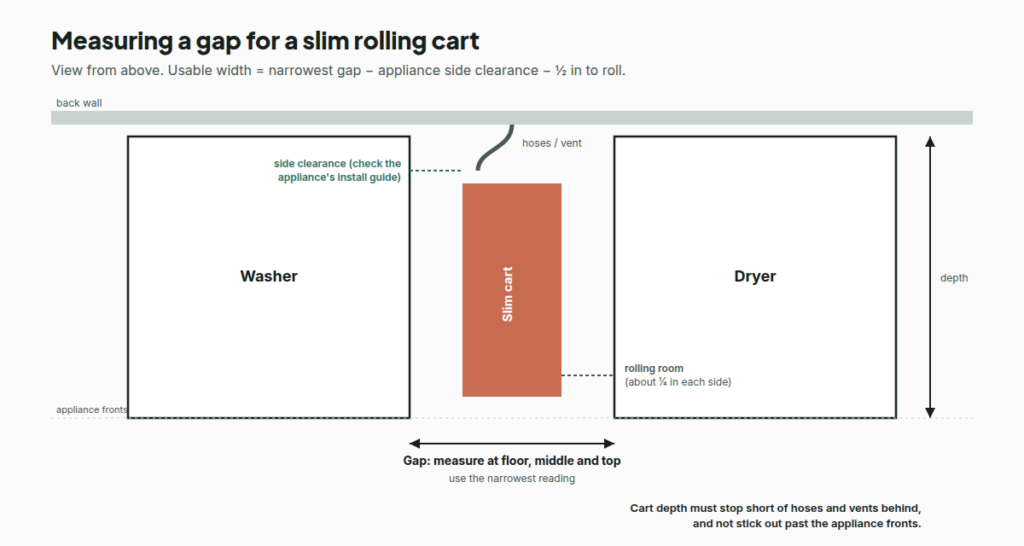
Measure the gap at the floor, the middle and the top, and use the narrowest reading. Subtract any side clearance your appliance’s installation guide asks for, then subtract about half an inch so the cart can roll. Whatever is left is the widest cart that fits. A 4.9-inch cart needs roughly a 5½-inch gap. A 7.1-inch cart needs about 7⅝ inches.
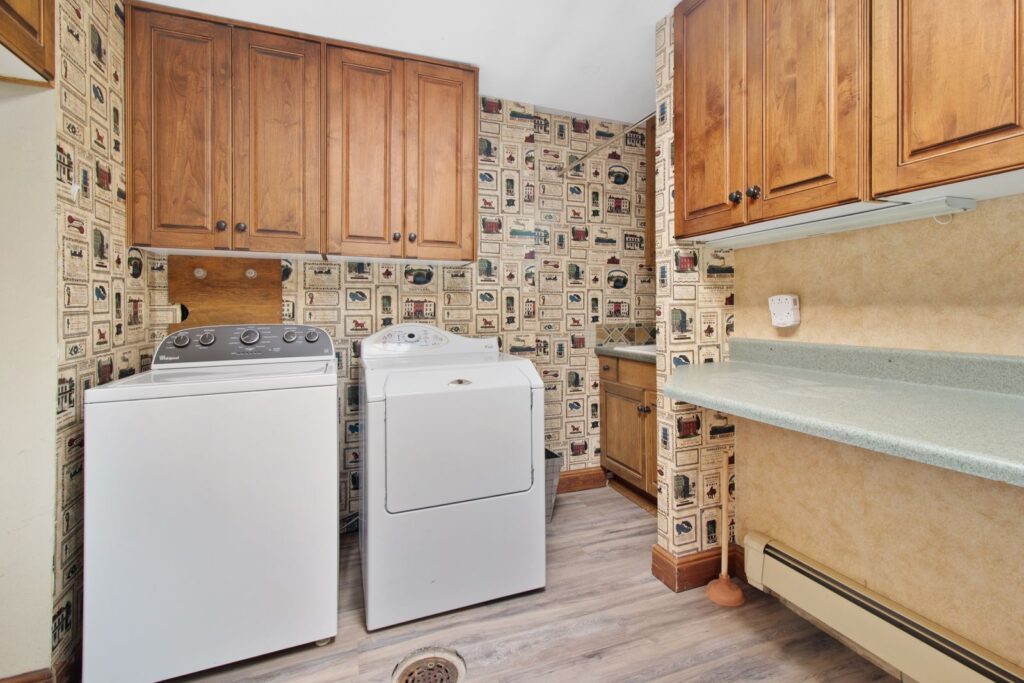
That narrow strip beside the fridge or between the washer and dryer is one of the few spaces in a small home that’s almost always empty. It’s also easy to get wrong, because appliance sides aren’t flat and the gap is rarely the same width from top to bottom.
How to measure the gap
- Width at three heights. Measure across the gap near the floor, at about waist height and near the top. Appliance panels bulge, countertops overhang and walls lean. Use the smallest number.
- Usable depth. Measure from the front edge of the appliances back to the first thing in the way: water hoses, a dryer vent, an outlet or the wall. The cart shouldn’t stick out past the appliance fronts, where you’ll kick it.
- Height. Measure up to anything above the gap, such as a countertop overhang, a shelf or wall cabinets.
- Check the floor. Look for a threshold, tile edge or flooring transition at the mouth of the gap. Small casters catch on them.
How much space do appliances need at the sides?
It depends on the model, so check your appliance’s installation guide (the model number is usually on a label inside the door or on the back). Two examples from manufacturers’ own documents:
- Washers and dryers: some Whirlpool laundry guides list a 0-inch minimum at the sides and recommend 1 inch, and suggest extra spacing around dryers to reduce noise transfer (Whirlpool dimension guide).
- Refrigerators: many GE installation manuals list about ⅛ inch at the sides and 1 inch at the top and back for air circulation (GE refrigerator installation instructions).
A cart standing next to an appliance is, in effect, a wall. Give the appliance the side clearance its guide asks for, then leave the cart a little room to roll. We use about half an inch in total as our own rule of thumb.
Two worked examples
A 6-inch gap between a washer and dryer. If your guide’s minimum side clearance is 0, then 6 − ½ leaves 5½ inches, and a 4.9-inch cart fits. If you follow the recommended 1 inch on each machine, then 6 − 2 − ½ leaves only 3½ inches, and it doesn’t. That’s a real trade-off: the extra spacing is about noise and vibration, not safety. If you squeeze a cart in, keep it from touching the machines so it doesn’t rattle during the spin cycle.
An 8-inch gap between a fridge and a cabinet. With about ⅛ inch for the fridge’s side clearance, 8 − ⅛ − ½ leaves about 7⅜ inches, so the 7.1-inch laundry cart fits. Keep its front behind the front of the fridge so the door and the cart’s handle don’t meet.
Two slim carts compared
| Cart | Size (W × D × H) | Gap you’d want | Shelves | Wheels |
|---|---|---|---|---|
| Slim 4-tier rolling cart | 4.9 × 15.3 × 38.7 in | About 5½ in | Two 12.5-in tiers below, two 9.2-in tiers above; up to 30 lb per shelf | 4 casters, 2 locking; removable |
| Slim metal laundry cart with wood top | 7.1 × 16.9 × 34.8 in | About 7⅝ in | 4 tiers with raised guardrails | 4 swivel casters, pull handle |
Height matters too. The 4.9-inch cart is 38.7 inches tall, which is taller than a typical countertop, so it won’t slide under an overhang. The 7.1-inch cart is 34.8 inches. Per its listing, the narrower cart’s 12.5-inch lower tiers are sized for detergent bottles.
Slim rolling carts for narrow gaps
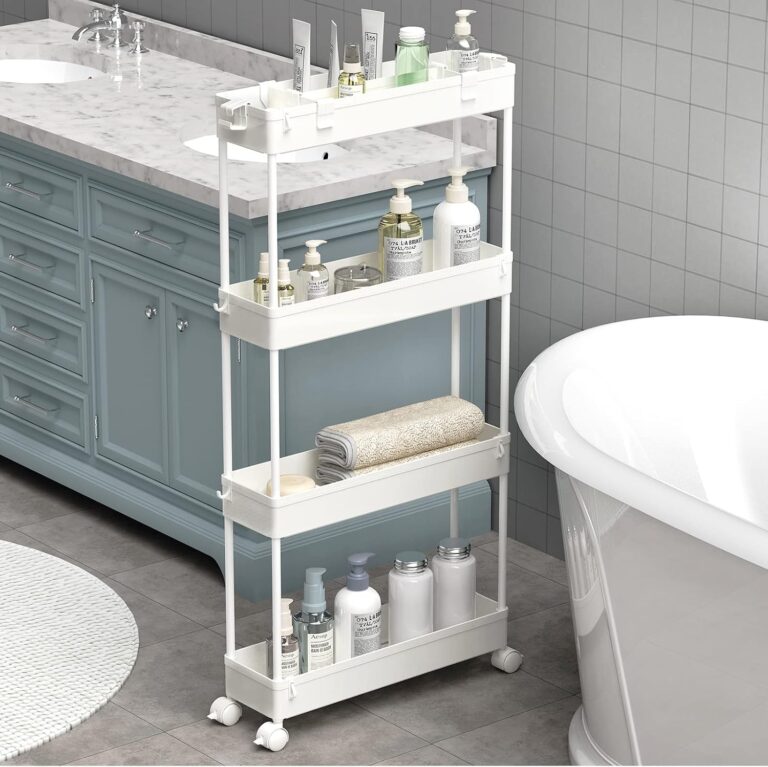
Slim 4-Tier Rolling Storage Cart (4.9" Wide)
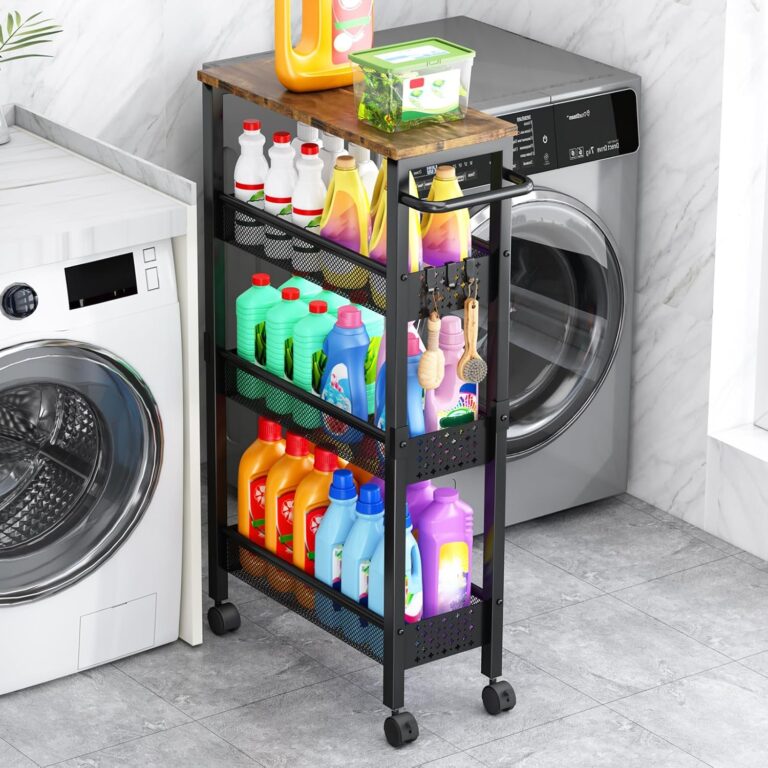
Slim Metal Rolling Laundry Cart with Wood Top (7.1" Wide)
Keeping a slim cart steady
- Put the heaviest things, like detergent, oil or cans, on the bottom tier. A tall, narrow cart tips more easily when it’s loaded at the top.
- Lock the casters once it’s in place (the 4.9-inch cart has two locking wheels).
- Beside a washer, leave a sliver of air between the cart and the machine so vibration doesn’t walk it out of the gap.
If there’s no gap at all
Use the side of the appliance itself, or the wall. Magnetic spice racks stick to the side of a steel fridge and hold spices, foil and wraps without any floor space. In a laundry room, a wall-mounted folding drying rack folds to 12 inches against the wall and extends to 51 inches when you need it. Per its listing, it holds up to 150 lb.
When there's no gap to fill
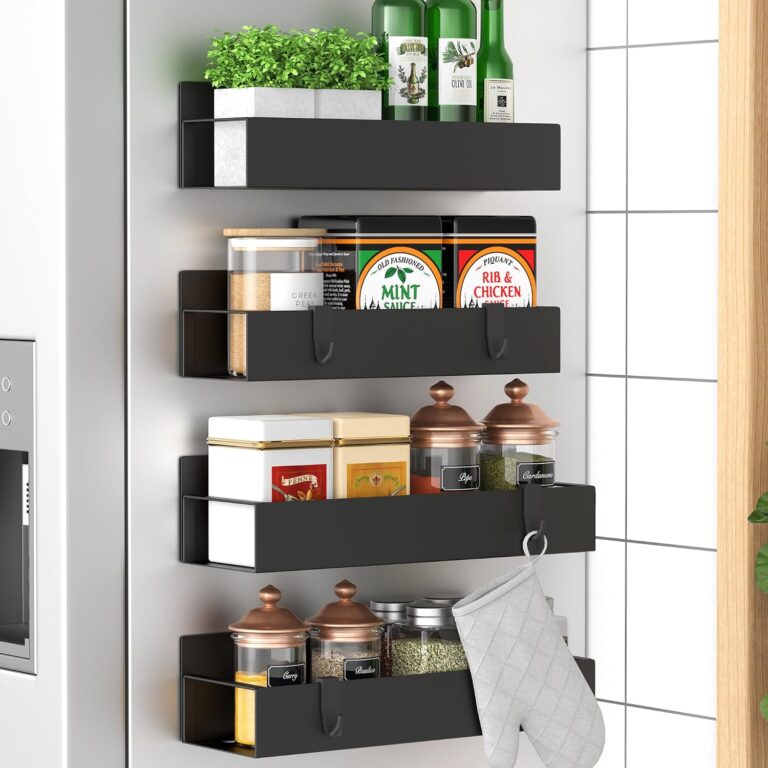
Magnetic Spice Racks for the Fridge (4-Pack, Black)
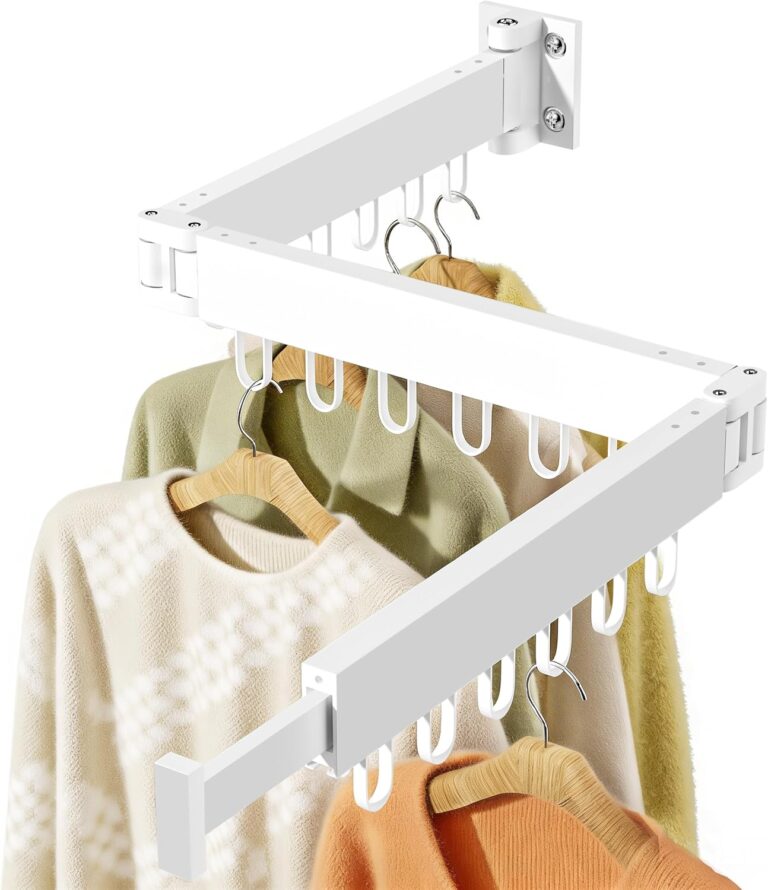
Wall-Mounted Folding Laundry Drying Rack (51" Arms)
Which one should you buy?
Start with your narrowest gap after any appliance clearance:
- 5½ to 7½ in gapSlim 4-Tier Rolling Storage Cart (4.9" Wide)Shop now
- 7⅝ in gap or widerSlim Metal Rolling Laundry Cart with Wood Top (7.1" Wide)Shop now
- No gap · steel fridgeMagnetic Spice Racks for the Fridge (4-Pack, Black)Shop now
- No gap · laundry wallWall-Mounted Folding Laundry Drying Rack (51" Arms)Shop now
The 4.9-inch cart fits the tightest spaces and has the most shelf height for bottles. The 7.1-inch cart is sturdier-looking, with a wood top and a handle, if you have the room. You can enter your measurements in our Will It Fit? tool, or browse all small-space storage.